# Filter reads

Next generation sequencing (NGS) data is notably huge in file size. Dealing with NGS data is not only time consuming but also puts constraints on hard disk space. This is especially true if analysis parameters need to be optimized. The *Filter reads* task is a very useful tool to get a subset of the raw data upon which optimization can be performed. The optimized parameters can then be saved and applied to the whole dataset.

*Filter reads* is only available for unaligned reads of FASTQ format. Select the *Unaligned Reads* data node then select **Filter reads** from the *Pre-alignment tools* section on the menu.

There are two options to filter reads: **Subsample reads** and **Filter by read length**.

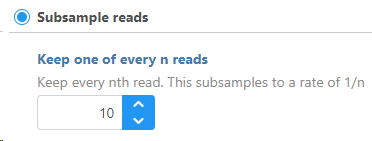
To *Subsample reads*, specify how many reads you want to keep for every nth reads. For example: if the user specifies to "Keep one read for every 10 reads" (Figure 1), this means that for every 10 reads, the program will keep only 1 read. This is equivalent to keeping 10% of the data.

<div align="left"><figure><img src="/files/BHt1tbNnlkaa96p5cX6z" alt=""><figcaption><p>Figure 1. By default, subsample raw data by keeping one read for every 10 reads</p></figcaption></figure></div>

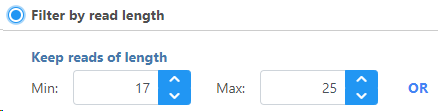
To *Filter by read length*, set the read length limits by choosing the minimum and maximum read length(s) to keep.

<div align="left"><figure><img src="/files/ZqLq4nfSdhuQ9WRlzCgz" alt=""><figcaption><p>Figure 2. Filter by read length(s) by setting the parameters for minimum and maximum read length</p></figcaption></figure></div>

## Additional Assistance

If you need additional assistance, please visit [our support page](http://www.partek.com/support) to submit a help ticket or find phone numbers for regional support.


---

# Agent Instructions: Querying This Documentation

If you need additional information that is not directly available in this page, you can query the documentation dynamically by asking a question.

Perform an HTTP GET request on the current page URL with the `ask` query parameter:

```
GET https://help.partek.illumina.com/partek-flow/user-manual/task-menu/pre-alignment-tools/filter-reads.md?ask=<question>
```

The question should be specific, self-contained, and written in natural language.
The response will contain a direct answer to the question and relevant excerpts and sources from the documentation.

Use this mechanism when the answer is not explicitly present in the current page, you need clarification or additional context, or you want to retrieve related documentation sections.